
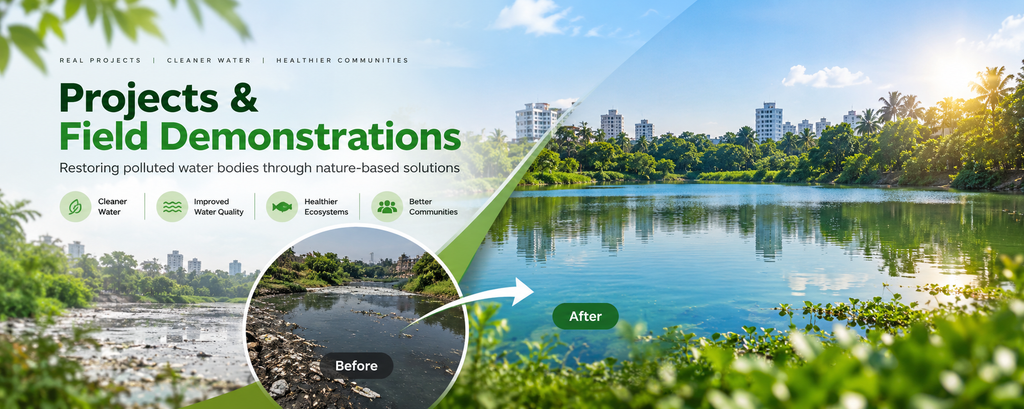
Advancing Water Restoration Through Nature-Based Technology
1. Gandhimanagar Sewage Stream Rejuvenation
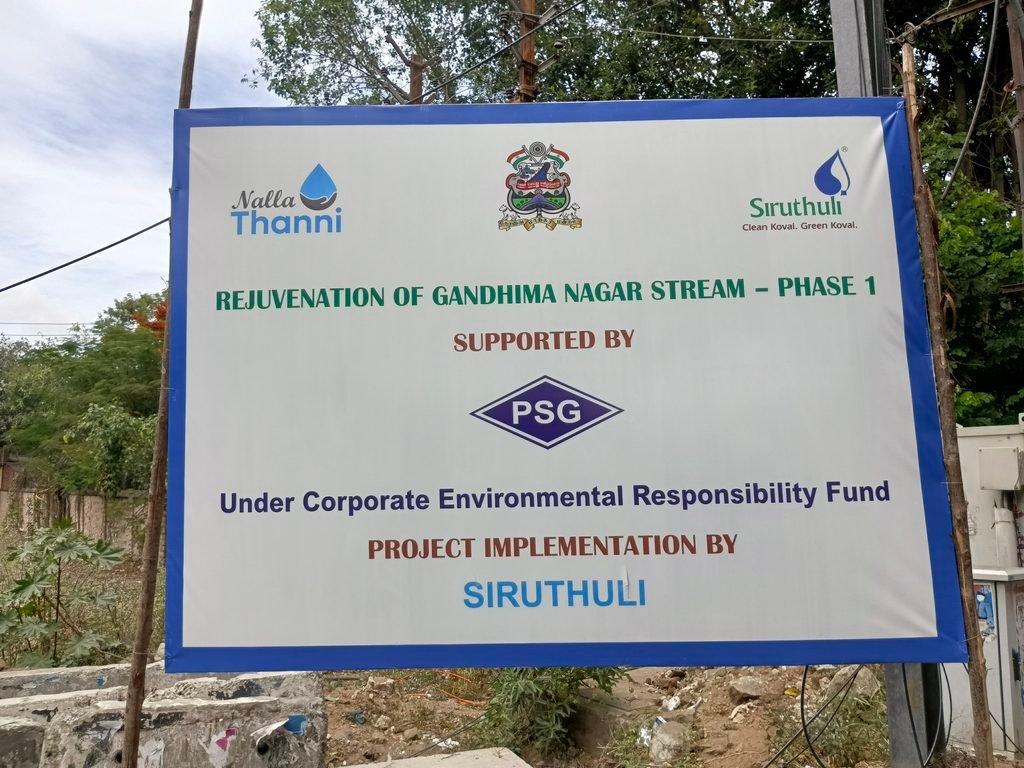
The Gandhimanagar project focuses on the biological treatment of a heavily polluted urban sewage stream extending from the Gandhimanagar Police Station towards the East Entrance of PSG Hospital. The dossier reports an approximate channel width of 10 metres and a flow volume of approximately 21 million litres per day (MLD).
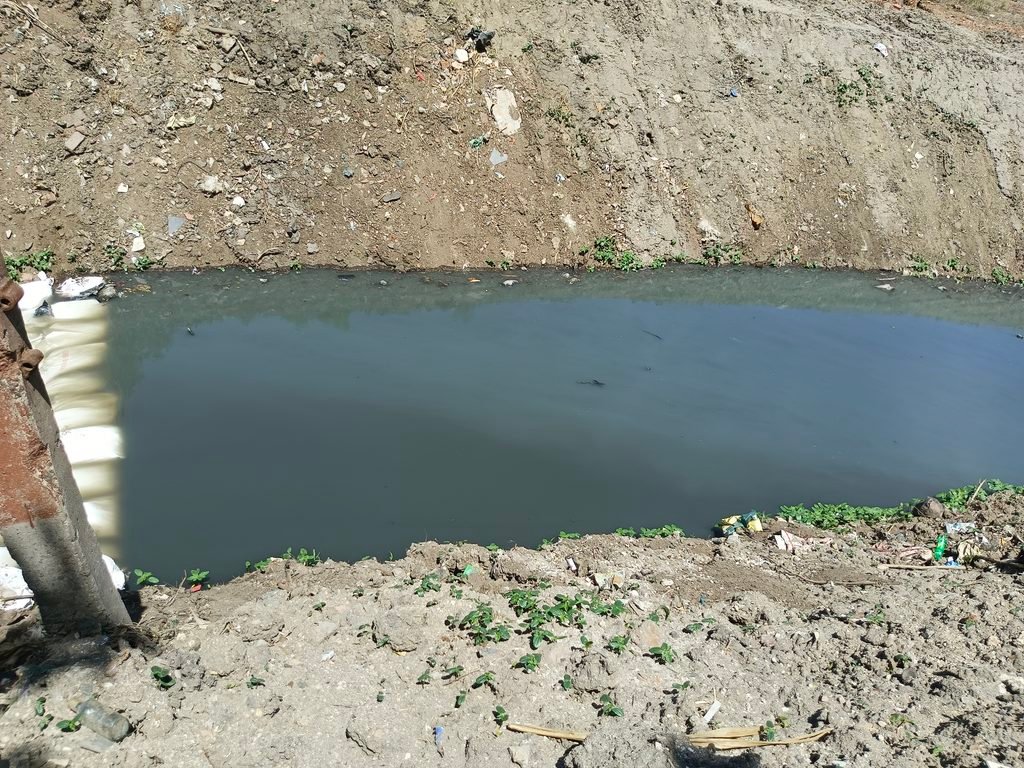
Before treatment, the stream exhibited dark water, severe sewage odour, mosquito breeding, accumulated sludge and high organic pollution.
Our approach
Ecolife Green Services, in association with its technology partner Nualgi, supplies treatment technology and materials and participates technically in the programme. The treatment combines diatom-based phyco-remediation with beneficial bacterial cultures and designated retention zones.
Water-quality testing is scheduled at regular intervals, with dissolved oxygen monitored separately to assess biological activity.
Reported field observations
- Noticeable reduction in sewage odour, reported within approximately three weeks.
- Cessation of extensive mosquito breeding, reported within approximately two weeks.
- A visible change in water appearance from predominantly black to a clearer condition during treatment.
- Oxygen bubbles observed at designated retention zones.
The project remains ongoing. These are interim field observations and should be interpreted alongside laboratory results and continued monitoring.
Ecolife’s role: Technology and treatment-material supply, with technical participation.
Final Treatment Zone at Fun Mall
2. Ruwa Sewage Pond Treatment Pilot
Location: Ruwa, Harare, Zimbabwe
Commenced: August 2025
Project overview
Ecolife Green Services initiated a pilot treatment programme for an approximately two-hectare sewage pond following direction from the Ruwa Town Board. The project assessed the application of Nualgi-based phyco-remediation under severely oxygen-depleted conditions.
At the beginning of the pilot, the average dissolved oxygen (DO) level was reported at just 0.38 mg/L.
Treatment approach
The treatment programme used Nualgi ELS Solution, with applications carried out periodically between 1 and 15 August 2025. Dissolved oxygen was measured in situ before applications, and water samples were submitted to the Environmental Management Agency (EMA) laboratory for analysis.
Reported interim observations
- Dissolved oxygen increased from 0.38 mg/L on Day 1 to a peak of 12.9 mg/L on Day 10.
- Foul odour was reported to have reduced noticeably within two days and become almost negligible within approximately one week.
- The interim laboratory report recorded improvements in several organic-pollution and microbiological indicators.
The pilot’s interim findings indicated a positive biological response. However, the treatment was discontinued before completion of the intended programme because adequate support to continue was unavailable and the pond was subsequently emptied for irrigation use.
Project significance: The pilot provided field-level evidence of the potential of biological treatment in a sewage-impacted pond. Results reflect the interim treatment period, not a completed restoration.
3. Nandivaram Thangal Lake Phyco-remediation
Location: Nandivaram–Guduvancheri, Chengalpattu District, Tamil Nadu
Reported project period: September 2023 – September 2024
Project overview
Nandivaram Thangal Lake is an urban lake of approximately 7.3 acres managed by Nandivaram–Guduvancheri Municipality. Its surroundings include stormwater drainage connections and a wider catchment that influences incoming water quality.
The project report documents a phyco-remediation programme focused on improving the condition of the lake through biological treatment.
Treatment focus
The approach centres on supporting beneficial diatom activity and the natural biological processes involved in water-quality improvement. Site conditions, pollution inputs and water-quality indicators are important considerations when evaluating the treatment response.
Project relevance
The lake project illustrates the application of phyco-remediation in an urban lake environment and the importance of evaluating water bodies in the context of their catchments and incoming drainage.
Project-specific implementation responsibilities and measured outcomes should be presented in accordance with the original project documentation.
4. Cooum Tributary Pilot – Virugambakkam
Location: Behind Taisha–AIS Housing Complex, Virugambakkam, Chennai
Reported project date: October 2019
Technical project head: N. Saravana Gopal
Project overview
This pilot addressed a severely polluted section of an urban tributary associated with the Cooum river system. The site presented challenges commonly encountered in sewage-contaminated urban channels, including organic pollution, unpleasant odour, mosquito breeding and poor water quality.
Treatment focus
The project explored the use of biological water-treatment technology and beneficial microbial processes in an urban waterway environment.
The experience is relevant to restoration planning for polluted drains and tributaries, where treatment selection must consider sewage inflow, water movement, retention time and the underlying sources of contamination.
Project relevance
Urban tributary projects can help inform site-specific strategies for improving water conditions. Sustainable restoration also requires appropriate sewage management, pollution-source control and continued monitoring.
Detailed performance claims should be supported by the project’s original monitoring records.
5. External Phyco-remediation and Beneficial Bacteria Demonstrations
Project references: Additional case studies documented in the technical dossier
Alongside Ecolife’s own project involvement, our technical dossier includes external project reports documenting the use of Nualgi-based phyco-remediation and beneficial bacterial treatment.
These case studies provide supporting evidence on the potential application of combined biological treatment approaches to sewage-impacted water bodies. Reported monitoring includes parameters such as biochemical oxygen demand (BOD), chemical oxygen demand (COD), total suspended solids (TSS), dissolved oxygen and microbiological indicators.
The results vary with site conditions, pollution loads, treatment duration and monitoring methods. Each project should therefore be evaluated on its own evidence and implementation context.
Transparency statement: External case studies are presented as supporting technology evidence and are not represented as projects directly executed by Ecolife Green Services Pvt. Ltd.
Our Project Implementation Approach
We follow a structured approach to water-body restoration:
- Site assessment – Evaluate the water body, catchment, pollution sources and hydraulic conditions.
- Baseline assessment – Establish initial water-quality and field conditions.
- Treatment planning – Develop a site-specific biological treatment strategy.
- Treatment implementation – Apply suitable phyco-remediation and beneficial microbial solutions.
- Monitoring – Track relevant water-quality parameters and field observations.
- Optimization – Adjust the programme according to site response and monitoring results.
- Performance evaluation – Review laboratory results, field observations and restoration objectives.
Biological treatment may need to be combined with sewage interception, solid-waste removal, sludge management and other interventions, depending on the site’s condition.
Partner With Ecolife for Water-Body Restoration
Ecolife Green Services works towards practical, evidence-based solutions for polluted lakes, ponds, urban drains and sewage-impacted water bodies.
We welcome opportunities to collaborate with government departments, municipalities, urban local bodies, CSR institutions, NGOs and other project stakeholders.
Planning a lake restoration or polluted water-body treatment project?
Contact Ecolife Green Services to discuss site assessment, treatment planning, technology deployment and monitoring requirements.
.